Pick an activity
Each one covers a different piece of the chemistry unit. Most hand you a verifiable progress code so you can grade without collecting a thing; Balancing Equations is pure practice, no names needed.
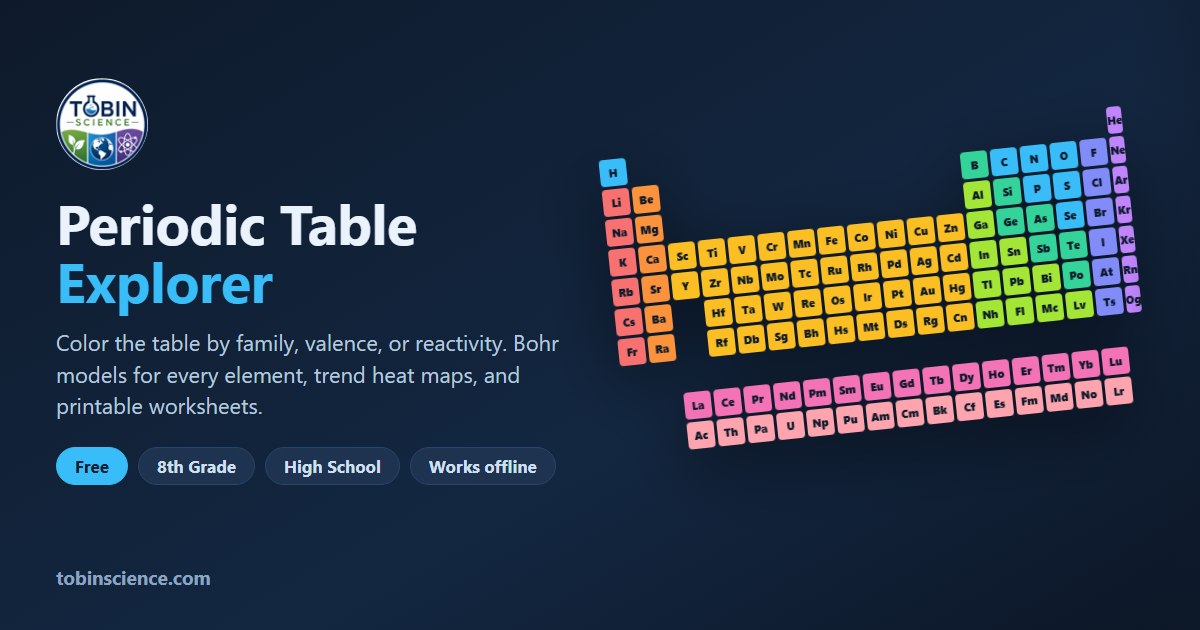
Periodic Table Explorer
An interactive periodic table that recolors itself however you need it to.
- Color all 118 elements by family, metal type, state, valence electrons, or reactivity with one click
- Open any element for its Bohr model, valence count, ion charge, and a real-world fact
- High School trend heat maps for atomic radius, ionization energy, and electronegativity
- Name-seeded practice with a code you can verify, plus five printable worksheets with keys
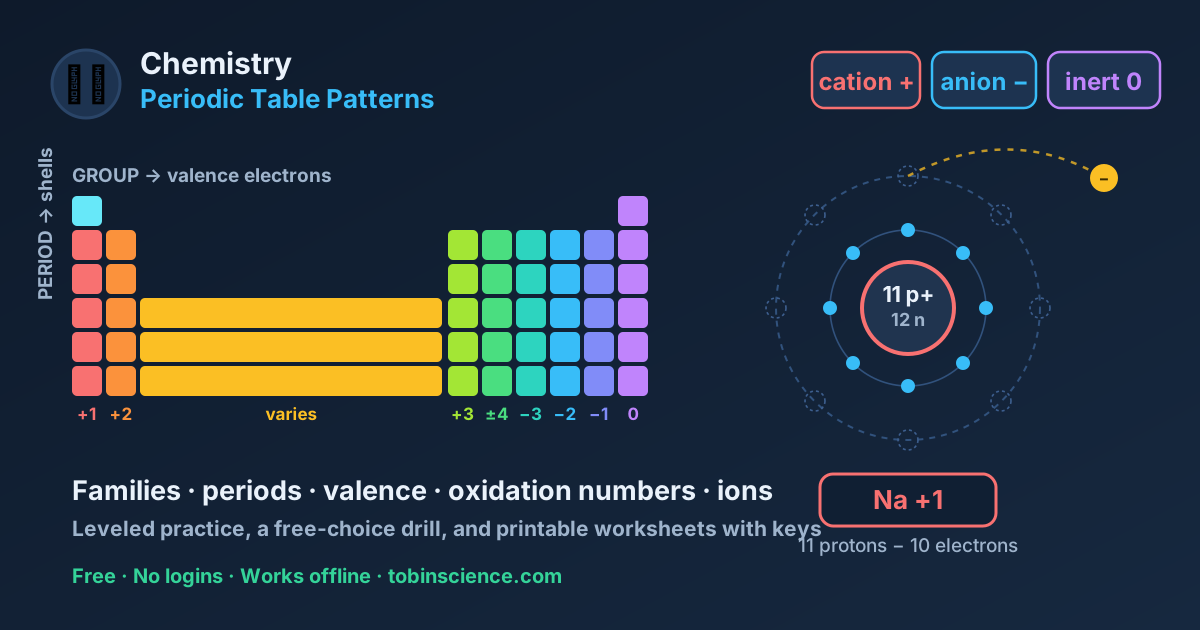
Periodic Table Patterns
How the table is organized — and the practice to make it stick.
- All ten families, hydrogen through the noble gases, one card each with the trick for remembering it
- Period = electron shells, group = valence electrons, drilled from both directions: name the count, then find the element
- Metals, nonmetals and metalloids, plus the oxidation number every column takes
- An Ion Lab that animates it — watch electrons leave and the atom go positive, watch them arrive and it go negative, and watch a full sodium-to-chlorine handoff
- A five-level ladder plus eight free-choice drills, so you can assign one skill or the whole unit
- Wrong answers get diagnosed — hydrogen called an alkali metal, group 17 read as 17 valence electrons, losing and gaining flipped
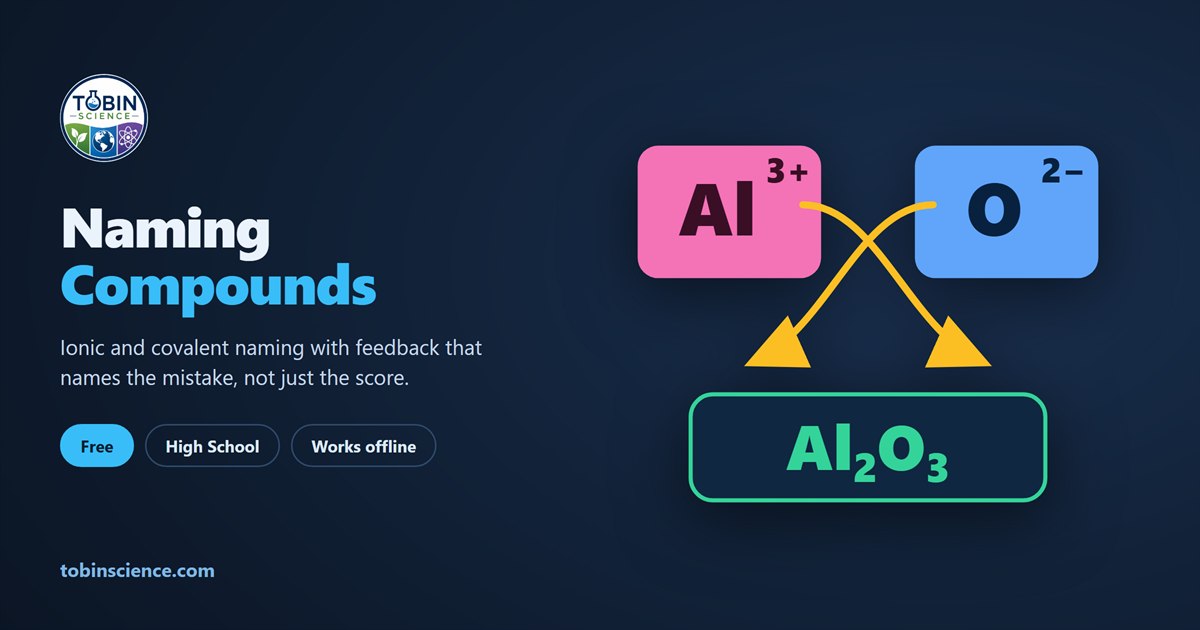
Naming Binary Compounds
Ionic and covalent naming, with feedback that names the mistake instead of just marking it wrong.
- A clickable naming flow chart, plus a namer that works both directions and shows every step
- Watch why the criss-cross method works, and watch the electrons transfer to match the formula
- Greek prefix flash cards and a sixty-second speed drill
- Wrong answers get diagnosed — prefixes on an ionic compound, a missing Roman numeral, a criss-cross that never got reduced — and each student finishes with a study list built from their own mistakes
- Transition metals and Roman numerals switch on and off, so you can teach it in two passes
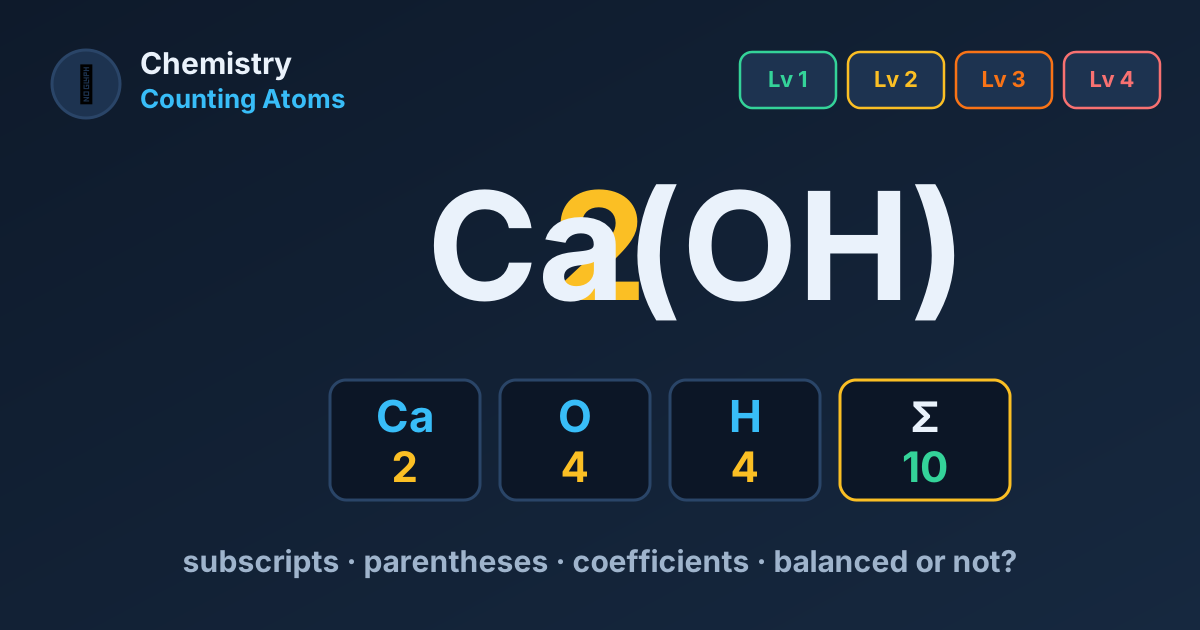
Counting Atoms
Four levels that ramp up — and feedback that names the exact counting mistake.
- Level 1 subscripts, Level 2 parentheses, Level 3 coefficients, Level 4 full equations
- A Formula X-Ray that counts any formula rule by rule, so students can see the method, not just the answer
- Wrong answers get diagnosed — ignored the parentheses, coefficient applied to only the first element, counted an element that isn't there
- Level 4 audits both sides of real equations and asks for the call: balanced or not?
- Name-seeded practice with a code you can verify, assignment links by level, plus four printable worksheets with keys
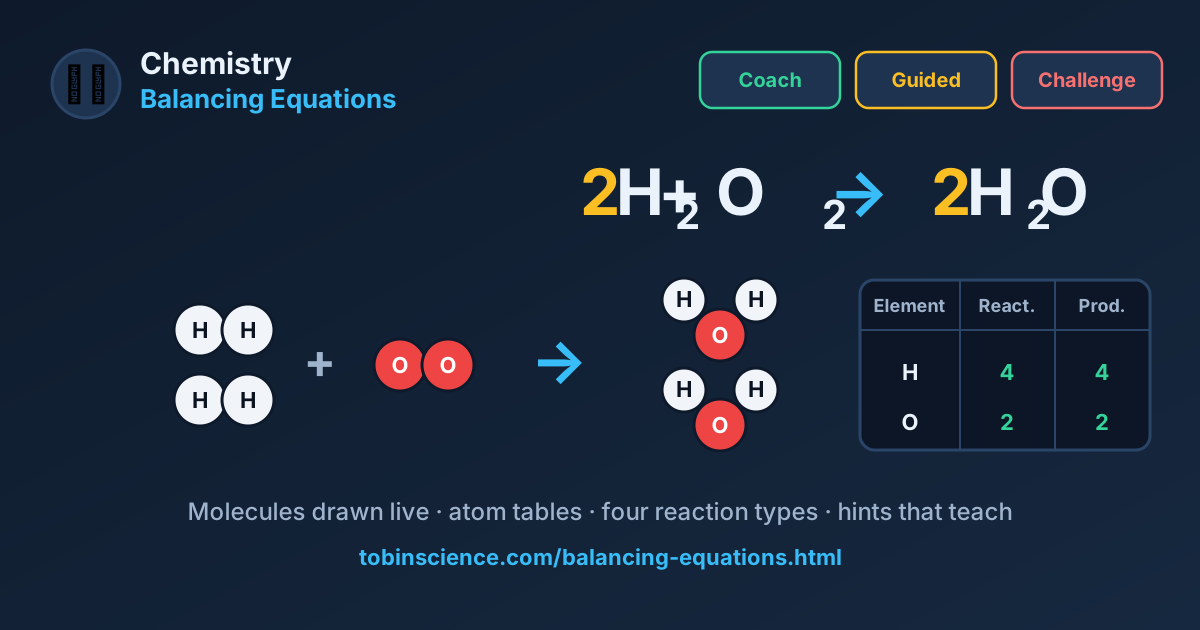
Balancing Chemical Equations
Three very different levels, molecules drawn live as the coefficients change, and reaction types built in.
- Level 1 is a coach that names the next element to fix and why. Level 2 is guided practice with three layers of hints. Level 3 brings coefficients up to 6 and polyatomic ions in parentheses
- Students count atoms in a reactants-and-products table, on paper or on the page, and the page checks the table against the equation as written
- Every equation also asks for the type: synthesis, decomposition, single or double replacement, with a clickable flow chart and a sixty-second speed drill
- Feedback names the exact problem — oxygen 2 on the left and 3 on the right, coefficients not in lowest terms, one number away
- Three worked examples that animate, a real-world reaction gallery, a common-mistake spotter, and five printable worksheets with keys. No names, no codes, just practice
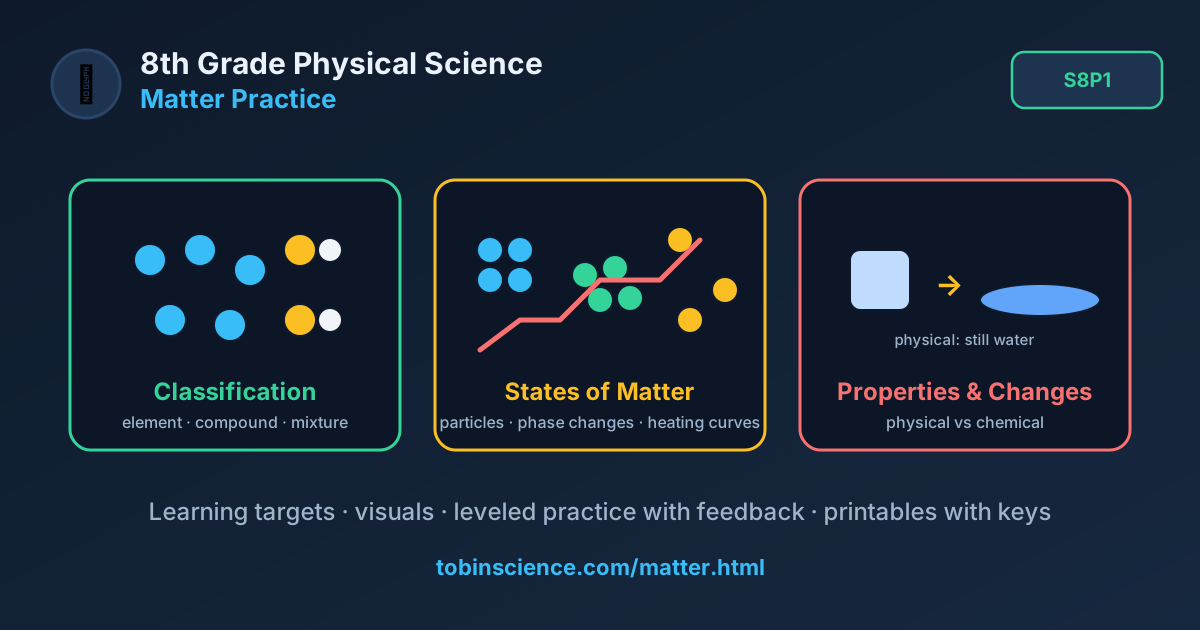
Matter Practice
Three 8th grade pages for the matter unit, each opening with learning targets and I-can statements.
- Classification of Matter: a clickable flow chart, particle pictures students read and sort, formulas as clues, and how mixtures come apart
- States of Matter: a live particle box (add or remove thermal energy), the six changes of state, and a click-a-segment heating curve
- Properties & Changes: one question that sorts physical from chemical, density as an ID card, the five signs of a chemical change, an evidence judge, and a CER builder
- Every page: three practice levels with feedback that explains, a speed round, and printable worksheets with keys. No names, no codes
Related
Other free tools that pair well with the chemistry unit.

Virtual Lab Bench
Fifteen interactive labs with virtual equipment — including atom building, conservation of mass, phase changes, and pH. Every student gets different numbers, and every lab hands you a verifiable code.
Open the Lab Bench →
Simple Science Videos
One-minute videos that break each Physical Science standard into plain language — good openers and reviews for the chemistry standards.
Browse the videos →