Tobin Science — Classification of Matter
Learning targets
- I can tell whether a sample is a pure substance or a mixture.
- I can use a particle picture to show the difference.
- I can classify a pure substance as an element or a compound using its formula or its particle picture.
- I can explain why a compound's properties are different from the elements that made it.
- I can classify a mixture as homogeneous or heterogeneous.
- I can name a physical way to separate a mixture and explain why a compound cannot be separated that way.
Everything is one of four things
Pick up anything: a penny, a glass of juice, the air. It is either a pure substance (one kind of particle all the way through) or a mixture (two or more kinds of particles just sharing space). Pure substances split into elements and compounds. Mixtures split into homogeneous and heterogeneous. Four boxes. That is the whole page.
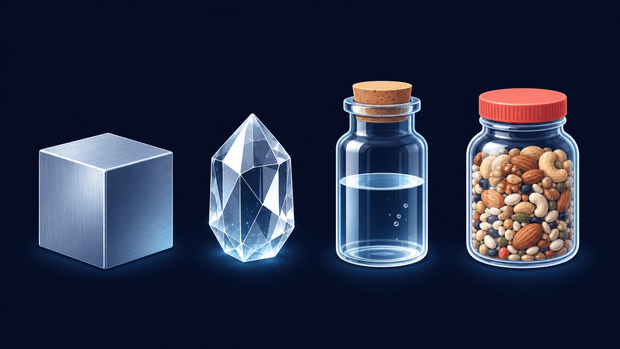
 One kind of atom. Copper is only copper atoms. Oxygen gas is only oxygen atoms (even though they travel in pairs, O2). It is on the periodic table.
 Two or more kinds of atoms chemically bonded in a fixed ratio. Water is always H2O. Salt is always NaCl. Its properties are brand new, not a blend of its elements.
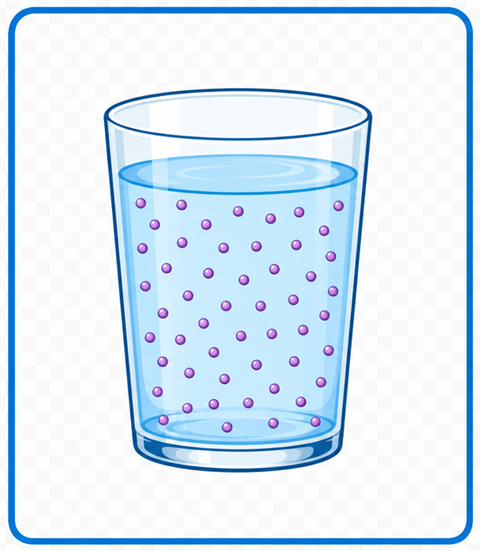
 Evenly mixed, looks the same throughout. You cannot see the parts. Sweet tea, salt water, air, brass. Also called a solution.
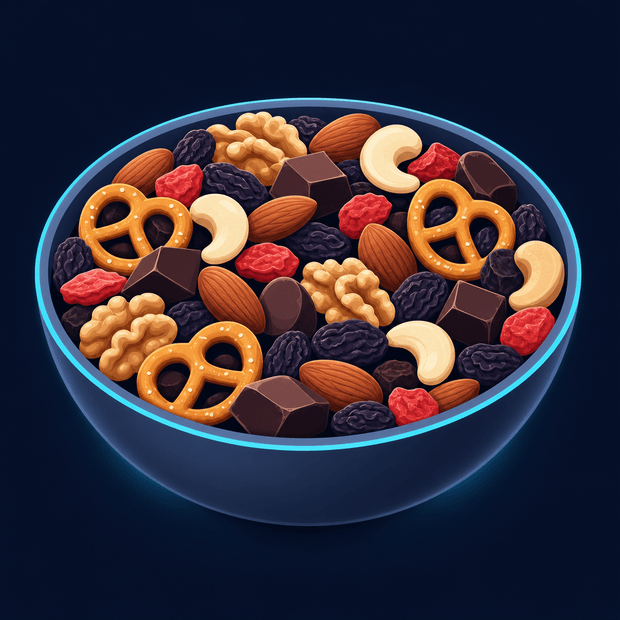 Unevenly mixed, you can see the parts. Trail mix, cereal in milk, sand in water, a pizza. Every scoop is a little different.
Step 1: pure substance or mixture?
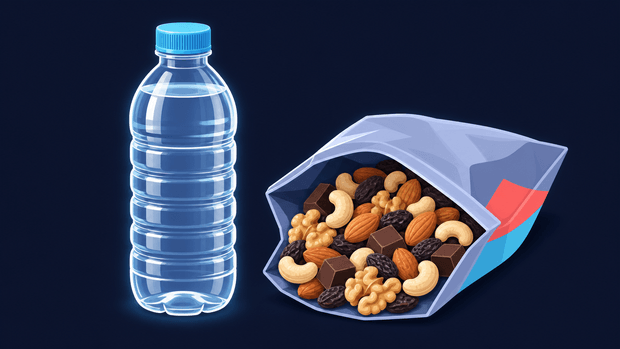
The test question: could you separate it without a chemical reaction? Pick the parts out, filter it, evaporate the water away, use a magnet. If yes, it is a mixture: the parts were only physically combined and each part keeps its own properties.
If the only way to break it down is a chemical change (electricity, burning, a reaction), it is a pure substance: one kind of particle, the same properties in every sample, all the way down.
Step 2a: pure substance, so element or compound?
Count the kinds of capital letters (each capital starts a new element symbol).
- Fe, He, O2, N2, O3 → one kind of symbol → element
- H2O, NaCl, CO2, C6H12O6 → two or more kinds → compound
Sodium is a soft metal that explodes in water. Chlorine is a poisonous green gas. Bond them and you get NaCl: the salt on your fries. A compound has its own new properties, nothing like the elements inside it.
Analogy: elements are letters, compounds are words. C-A-T is always those three letters in that order. Change a letter and it is a different word. Change the ratio in a compound and it is a different substance (H2O is water, H2O2 is hydrogen peroxide).
Step 2b: mixture, so homogeneous or heterogeneous?
Homo- means same. A homogeneous mixture looks the same everywhere: the particles are spread out evenly and too small to see. Every sip of sweet tea tastes the same. Air is a homogeneous mixture of nitrogen, oxygen, and a few other gases.
Hetero- means different. A heterogeneous mixture has parts you can see, and one scoop is not the same as the next. Cereal in milk, a salad, sand in water, granite.
How mixtures come apart
Every one of these is a physical method. Each part keeps its own properties, so you use those properties to pull it out.
Reading particle pictures
On the test you will see boxes of circles. Here is how to read them. Each color is a different kind of atom. Circles touching are bonded into one particle.
The flow chart
Click your way down. Then hit Quiz me and walk the chart with a real item.
One-minute video
Simple Science: pure substances versus mixtures, in about a minute. Needs wifi.
Show the video
How are you feeling about this today?
Nothing here is graded. Switch levels any time.
Printable worksheets
Student page first, answer key on the next page. Shuffle to pull a fresh set.
Standard and targets
Georgia S8P1a — Develop and use a model to compare and contrast pure substances (elements and compounds) and mixtures. The particle pictures are the model; the flow chart is the compare-and-contrast.
- Target 1: pure substance vs mixture, with a particle picture.
- Target 2: element vs compound from a formula or picture; why compound properties are new.
- Target 3: homogeneous vs heterogeneous; a physical separation method; why a compound cannot be separated physically.
How the levels differ
Misconceptions this page targets
- "O2 is a compound because it has a subscript." The formula section and Level 2 hit this repeatedly.
- "Dissolved salt disappears or becomes water." Solution particle picture plus the evaporation separation method.
- "Air is a pure substance" and "brass is an element." Both are homogeneous mixtures; Level 3 items.
- "Homogeneous means pure." A solution is two substances, evenly mixed. The four-box grid keeps the columns apart.
Pairs with the Unit 2 guided notes Part 1 and the FuseSchool "Element, Mixture or Compound?" clip. Nothing is collected: no names, no codes.