Tobin Science — States of Matter
Learning targets
- I can describe how particles are arranged and how they move in a solid, a liquid, a gas, and plasma.
- I can match a particle picture to its state.
- I can explain what happens to particle motion when thermal energy is added or removed.
- I can explain that temperature measures the average kinetic energy of the particles.
- I can name the change between any two states (melting, freezing, vaporization, condensation, sublimation, deposition) and give a real example.
- I can explain why a change of state is a physical change.
- I can read a heating curve and say which state the substance is in on each part.
- I can explain why the temperature stays flat while a substance melts or boils.
Three ideas: the kinetic molecular theory (8th grade version)
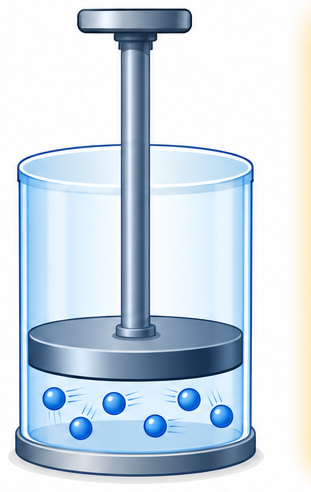
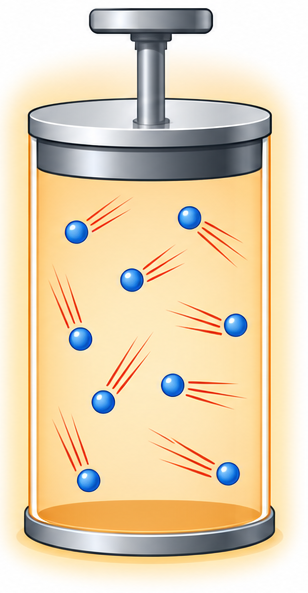
The particle box: add energy, take it away, watch
Sixty particles of one substance. Drag the slider or use the buttons. Watch what changes and what stays the same.
The four states, particle by particle
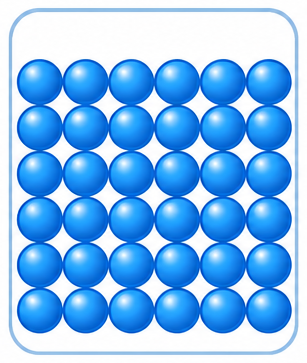
- Packed tightly in a fixed pattern
- Particles vibrate in place
- Definite shape, definite volume
- Lowest energy of the four
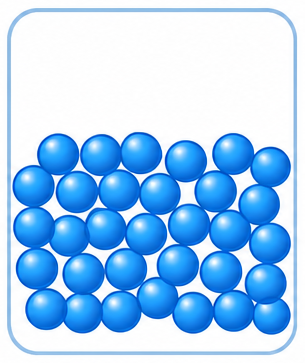
- Close together but not in a pattern
- Particles slide past each other
- Takes the shape of its container, definite volume
- Can flow and be poured
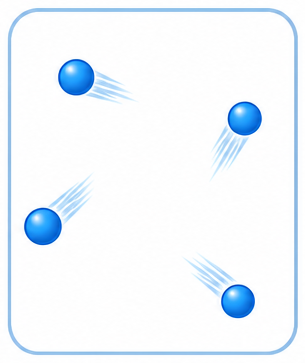
- Far apart, mostly empty space
- Particles fly freely and bounce
- No definite shape, no definite volume: fills the container
- Easy to squeeze (compress)
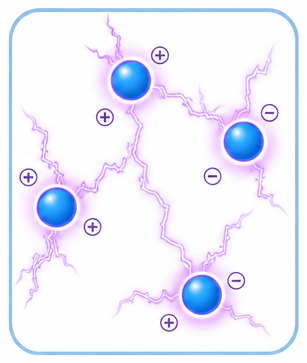
- A gas with so much energy that electrons get knocked off
- Particles are charged (ions and free electrons)
- Glows, conducts electricity
- Highest energy of the four
- The most common state of matter in the universe. Every star, including the Sun, is plasma. Over 99% of the visible universe.
- On Earth: lightning, neon signs, the northern lights, plasma TVs, the inside of a fluorescent bulb.
- Not the plasma in blood. Same word, completely different thing. Blood plasma is a liquid.
- The sequence solid → liquid → gas → plasma is just more and more thermal energy.
Changes of state
Click any arrow. Adding thermal energy moves you right (particles speed up and spread out). Removing it moves you left.

Reading a heating curve
A heating curve is a graph of temperature (up) against time while you add heat steadily (across). Click each part of the line.
One-minute videos
Simple Science, in about a minute each. Needs wifi.
States of matter (S8P1b)
Heating curves
How are you feeling about this today?
Nothing here is graded. Switch levels any time.
Printable worksheets
Student page first, answer key on the next page. Shuffle to pull a fresh set.
Standard and targets
Georgia S8P1b — Develop and use models to describe the movement of particles in solids, liquids, gases, and plasma states when thermal energy is added or removed. The particle box simulator and the particle pictures are the models. Heating curves are included because the Milestones-style questions lean on them and they connect to the same idea: energy in, motion up.
- Target 1: particle arrangement and motion in all four states.
- Target 2: thermal energy added or removed → particle speed; temperature as average kinetic energy.
- Target 3: the six changes of state with examples; changes of state are physical.
- Target 4: reading a heating curve; why the plateaus are flat.
How the levels differ
Classroom notes
- Kinesthetic version: students are the particles. Shoulder to shoulder jiggling = solid. Walking around each other slowly in a group = liquid. Spread across the room, moving fast = gas. Four minutes, never forgotten.
- Project the particle box and ask "what changed, what stayed the same?" as you drag the slider. The particle count never changes; that sets up conservation later.
- Heating curve on the board: draw it live, narrating "climb... flat while melting... climb... flat while boiling." The flat parts are the surprise and the favorite test question.
- Real-world hooks: sweat cools you because evaporation takes energy from your skin. Freezer frost is deposition. Dry ice fog at a haunted house is sublimation.
- Misconceptions handled on the page: particles stop in a solid; cold is added; plasma is blood plasma; plasma is rare; temperature always rises when heating.
- Nothing is collected: no names, no codes. Pairs with Unit 2 guided notes Part 2 and the Melt & Boil lab on the Virtual Lab Bench.