Light and Sound: Waves, the Spectrum, Behaviors and Lenses
Simulations, a wave maker, a bell-jar test, speed races, a click-the-spectrum explorer, a design-a-device challenge, a sound lab you can hear, wave behaviors, a lens bench, endless wave practice, worked examples and review for every part of S8P4.
Start here
What you are learning
S8P4. Obtain, evaluate, and communicate information to support the claim that electromagnetic (light) waves behave differently than mechanical (sound) waves. a. Ask questions to develop explanations about the similarities and differences between electromagnetic and mechanical waves. b. Construct an explanation using data to illustrate the relationship between the electromagnetic spectrum and energy. c. Design a device to illustrate practical applications of the electromagnetic spectrum (e.g., communication, medical, military). d. Develop and use a model to compare and contrast how light and sound waves are reflected, refracted, absorbed, diffracted or transmitted through various materials. e. Analyze and interpret data to predict patterns in the relationship between density of media and wave behavior (i.e., speed). f. Develop and use a model (e.g., simulations, graphs, illustrations) to predict and describe the relationships between wave properties (e.g., frequency, amplitude, and wavelength) and energy. g. Develop and use models to demonstrate the effects that lenses have on light (i.e., formation an image) and their possible technological applications.
Learning targets
Identify similarities and differences between electromagnetic and mechanical waves
Describe the relationships between wave properties and energy
Analyze how waves behave differently in different mediums
Explain how the amount of energy determines the different types of electromagnetic waves
Apply the electromagnetic spectrum to practical everyday uses
Explain how light and sound waves are reflected, refracted, absorbed, diffracted and transmitted
Use lenses to make light behave in ways that help us every day
Success criteria
I will be successful when I can:
compare and contrast electromagnetic and mechanical waves
measure the wavelength, amplitude and frequency of a wave
relate wavelength, amplitude and frequency to the amount of energy in a wave
use real-world examples to explain how wave speed changes in different media (states of matter)
explain and illustrate the energy of each type of electromagnetic wave using data
identify and describe real-world uses of the EM spectrum
compare how light and sound reflect, refract, absorb, diffract and transmit through materials
make and use models of what lenses do to light and where lenses are used
1Wave basics
Energy, not matter. Amplitude, wavelength, frequency and speed.
2The EM spectrum
Radio to gamma: shorter wavelength means more energy.
3Sound
Vibrations, pitch, loudness and why solids carry sound fastest.
4Wave behaviors
Reflect, refract, absorb, transmit, diffract. Light and sound both do all five.
5Lenses & mirrors
Curved glass bends light into images: cameras, glasses, microscopes.
A wave is a disturbance that carries energy from one place to another without carrying matter. A duck on a pond bobs up and down as a wave passes; it does not surf across the pond. Every single thing you have ever seen or heard reached you as a wave.
Part 1 · S8P4.f
Wave maker: amplitude, wavelength, frequency and energy
Shake a rope. Amplitude is how tall the wave is (rest position to crest). Frequency is how many waves you make each second. Wavelength is the distance from one crest to the next. Move the sliders and watch what responds. One thing never changes no matter how hard you shake: the speed. The rope sets that.
WavelengthResponds
EnergyResponds
Wave speedSet by the rope
Amplitude ↑more energyA louder shout, a brighter flashlight, a taller ocean wave. Measured from the rest position to a crest, not crest to trough.
Frequency ↑more energy, shorter wavelengthMore waves per second deliver more energy. On the same rope, more waves have to fit in the same space, so each one gets shorter.
Speedset by the medium onlyShake harder or faster and the wave still crosses the rope in the same time. A whisper and a shout reach you together.
Label the wave
Match each letter to the wave part. Watch out for the classic trap: amplitude is rest position to crest, so crest to trough is double the amplitude.
The wave equation, kept simple
wave speed = frequency × wavelength, or v = f × λ. If a rope makes 4 waves every second (f = 4 Hz) and each wave is 2 m long (λ = 2 m), the energy travels 4 × 2 = 8 m every second.
Flip it around when you need to: f = v ÷ λ and λ = v ÷ f. Because the speed is fixed by the medium, frequency and wavelength are a see-saw: when one goes up, the other goes down. Try it in the wave maker: raise the frequency and watch the wavelength shrink while the speed meter stays put.
Part 2 · S8P4.a
Light vs. sound: the bell jar test
A ringing phone sits inside a glass jar. Pump the air out. Sound is a mechanical wave: it needs a medium (matter to travel through), so it fades as the air disappears. Light is an electromagnetic wave: it needs no medium at all, so the screen stays just as bright. That is why space movies lie to you: in a vacuum, no one can hear the explosion.
Air in the jarYou
Sound you hearResponds
Light you seeResponds
Mechanical waves
Electromagnetic (EM) waves
Needs a medium?
Yes. Must have matter (solid, liquid or gas) to travel through.
No. Can cross empty space, a vacuum.
Examples
Sound, ocean waves, earthquake (seismic) waves, a wave on a slinky or rope.
Visible light, radio waves, microwaves, infrared, UV, X-rays, gamma rays.
Speed
Depends on the medium. Sound in air: about 343 m/s.
In a vacuum, all of them travel at the same speed, 300,000 km/s: the speed of light.
Shape
Transverse (rope) or longitudinal (sound, slinky push).
Always transverse.
What is the same?
Both carry energy, both have amplitude, wavelength and frequency, and both can be reflected, refracted, absorbed, transmitted and diffracted.
Sort it: mechanical or electromagnetic?
Ask a question. A radio in a sealed vacuum jar still picks up the station. A speaker in the same jar makes no sound you can hear. What question would you ask to figure out why, and what is the answer?
"Which of these waves needs matter to travel through?" Radio waves are part of the light family, so they cross the vacuum and reach the antenna. The speaker's sound is a mechanical wave: with no air in the jar, there is nothing to carry the vibration to the glass, so nothing reaches your ears.
Part 3 · S8P4.e · Analyze and interpret data
Speed and media: race a wave through air, water and steel
Press start and watch how far each pulse gets in the same slow-motion time. Then switch to light and run it again. Look for the pattern, because sound and light do the opposite thing when the medium gets denser.
Medium
State
Speed of sound
Speed of light
Air (20 °C)
gas
343 m/s
about 300,000 km/s
Water
liquid
about 1,480 m/s
about 225,000 km/s
Glass / steel
solid
about 5,960 m/s (steel)
about 200,000 km/s (glass)
Sound speeds UP in denser mediasolids › liquids › gasesIn a solid the particles are packed tightly, so each one bumps its neighbor almost instantly and the vibration passes along fast. In a gas the particles are far apart, so handing the vibration along takes longer.
Light slows DOWN in denser mediaair › water › glassLight does not need particles to carry it; particles get in its way. More matter to pass through means a slower trip. This slowing is what makes light bend (refract), coming up in Part 7.
Flash to boom. Light from lightning reaches you almost instantly. Thunder crawls along at about 343 m/s, roughly 3 seconds for every kilometer. Count the seconds between the flash and the boom:
Predict. An old-time trick: put your ear on a steel railroad rail and you can detect a far-off train before you hear it through the air. Why?
The rail is a solid. Sound travels about 17 times faster in steel than in air, so the vibration arrives through the rail long before the sound through the air does.
Part 4 · S8P4.b · Explain using data
The electromagnetic spectrum: click a band
Radio, microwave, infrared, visible, ultraviolet, X-ray and gamma are all the same kind of wave, light, at different wavelengths. All of them cross empty space at the speed of light. What changes from band to band is the wavelength, the frequency and, with them, the energy. Click each band and watch the wave itself change.
◀ Longest wavelength · lowest frequency · lowest energyShortest wavelength · highest frequency · highest energy ▶
Wavelength
Frequency
Energy
Speed in spaceAlways the same300,000 km/s
The data: how the bands compare
Wavelength sizes are the usual comparisons used by NASA. The energy bars are a ranking, not measurements: each band's waves carry more energy than the band to its left, and the jump from radio to gamma is enormous.
Visible light: the rainbow slice
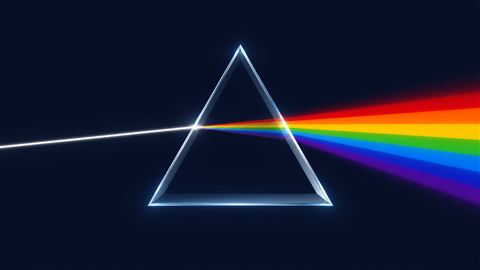
Our eyes detect only one thin band. Slide across it from red to violet (ROYGBIV).
Red
Say it as one chant
Short wavelength = high frequency = high energy. Moving from radio toward gamma, the wavelength gets shorter, the frequency gets higher and the energy gets higher. All three change together, always.
Memory trick for the order, low energy to high: Real Musicians Improvise Very Unique Xylophone Grooves.
Energy and safety. Low-energy bands (radio, microwave, infrared) pass by you all day at safe everyday levels. That is why the air can be full of radio and Wi-Fi signals. High-energy bands (ultraviolet, X-ray, gamma) carry enough energy to damage living cells. That is why you wear sunscreen, why the dentist drapes a lead apron over you, and why the X-ray tech steps behind a shield.
Explain with data. A radio wave and a gamma ray both travel at the speed of light. Use the chart above to explain why one is safe to fill the air with and the other needs shielding.
Both are EM waves and both travel at the same speed, so speed is not the difference. The data show that gamma rays have a wavelength smaller than an atom's nucleus while radio waves are as long as buildings. Shorter wavelength means higher frequency, and higher frequency means more energy per wave. Gamma rays carry enough energy to break apart the molecules in living cells, so they need shielding. Radio waves carry so little energy per wave that they pass through you without doing harm.
Part 5 · S8P4.c · Design a device
Design a device: which band does the job?
Engineers pick a band of the spectrum for a reason: its wavelength and energy fit the job. Pick a job, then pick the band your device should use. Each right answer goes on your design sheet. Three kinds of jobs are here: communication, medical and military / detection, plus some everyday ones.
My device sheet
Now design your own
Invent a device. Give it a name, choose its band, say what it does and add one safety note. Then copy your design to turn in.
My design
Part 6 · S8P4.a · S8P4.f
Sound: two separate dials, pitch and loudness
Every sound starts as a vibration: a string, a drumhead, your vocal cords. The vibration pushes the air into compressions (squeezed) and rarefactions (spread out), a longitudinal wave. Pitch is set by frequency. Loudness is set by amplitude. Move one dial at a time, and press play to hear it.
PitchFrom frequency
LoudnessFrom amplitude
Speed in airSet by the air343 m/s
The tone is kept quiet on purpose. If you hear nothing, turn your device volume up a little. The pitch range here is well inside what people hear, about 20 Hz to 20,000 Hz. Above that is ultrasound (dog whistles, the sonograms doctors use), below it is infrasound (elephants rumble to each other with it across kilometers).
Loudness in decibels (dB)
Turning up the volume changes amplitude, not pitch. A tuba and a piccolo can play at the same loudness; a whisper and a shout can have the same pitch. Two separate dials.
Which dial moved? A singer holds one note, then sings the same note louder. Which wave property changed, and which stayed the same?
Amplitude went up (louder). Frequency stayed the same, because it is the same note (same pitch). And the sound still crossed the room at the same speed, because the air sets the speed.
Part 7 · S8P4.d · Develop and use a model
Wave behaviors: what happens when a wave meets a material
When a wave reaches a new material or an obstacle, one or more of five things happens. Light and sound both do all five. Pick a behavior and play with the model.
Reflectionbounces offMirror; an echo in a gym. Angle in equals angle out, both measured from the normal.
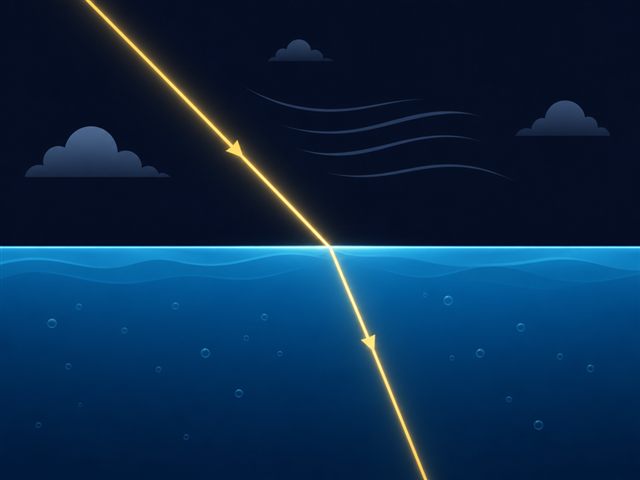
Refractionbends in a new mediumA straw looks broken in a glass of water. The wave changes speed, so it changes direction.
Absorptionenergy taken inA dark T-shirt getting hot in the sun; curtains soaking up sound.
Transmissionpasses throughLight through a window; sound through a thin wall.
Diffractionspreads aroundHearing friends around a corner; bass thumping through a doorway.
Behavior
Light does it when…
Sound does it when…
Reflection
it hits a mirror or calm water (smooth = clear reflection; rough = scattered)
it hits a hard, smooth wall: an echo, sonar, a bat's echolocation
Refraction
it passes from air into water or glass at an angle and slows down, bending toward the normal
it passes between warm and cool air, or into water, and changes speed
Absorption
it hits a dark surface: the energy becomes heat
it hits carpet, curtains or foam: the energy becomes a tiny bit of heat
Transmission
it passes through transparent glass or water
it passes through a door, a wall or water
Diffraction
it squeezes through a tiny slit; visible light's wavelength is so small it barely bends around a corner
it goes through a doorway or around a corner; long sound wavelengths spread a lot
Same corner, different wavelength. You can hear your friend around a corner but you cannot see them. Sound wavelengths are about the size of doorways, so sound diffracts a lot. Visible light wavelengths are far smaller than a hair, so light barely bends at all.
Which behavior is it?
Name the behavior in each scene, then check. Shuffle for new scenes.
Part 8 · S8P4.g · Develop and use a model
Lens bench: shaped glass that bends light into an image
A lens is a curved piece of transparent material that refracts light in a controlled way. A convex lens is thicker in the middle and converges (brings together) light to a focal point. A concave lens is thinner in the middle and diverges (spreads) light. Slide the object closer and farther and watch the image.
Real imagelight actually meets thereUpside down, and it can be projected on a screen. Cameras, projectors and your own eye (your brain flips the picture).
Virtual imageonly exists when you look throughUpright. A magnifying glass makes a virtual image that is larger; a concave lens makes one that is smaller.
Memory trickwhich lens is whichConCAVE lenses "cave in" at the middle and spread light out. Concave lenses never make a real image, because the rays never meet.
Mirrors: shaped surfaces that reflect
Lenses work by refraction; mirrors work by reflection. A metal spoon is both curved mirrors at once: the inside bowl is concave, the back is convex.
Which optical tool?
Decide which lens or mirror each device needs, then check.
Part 9 · S8P4.f
Wave practice (it never runs out)
Every question is made fresh, with a new wave drawn on the grid, so you can practice as long as you want. Pick a skill or leave it on Mixed. After you answer, the drawing shows exactly where the answer came from.
Part 10
Worked examples, step by step
Make your own guess for each step before you reveal it.
Part 11
Waves in real life
Decide which idea explains each one before you flip the card.
Part 12
Myth or fact?
The most common mix-ups about waves, light and sound. Decide, then see the truth.
Part 13
Practice: the whole unit
Ten questions at a time from every part of S8P4: wave properties and energy, mechanical vs. electromagnetic, speed in different media, the spectrum and its uses, sound, behaviors, and lenses. Press New set any time for different questions.
Sort it: which band does the job?
Choose the band of the spectrum for each use, then check your sort.
 Tobin