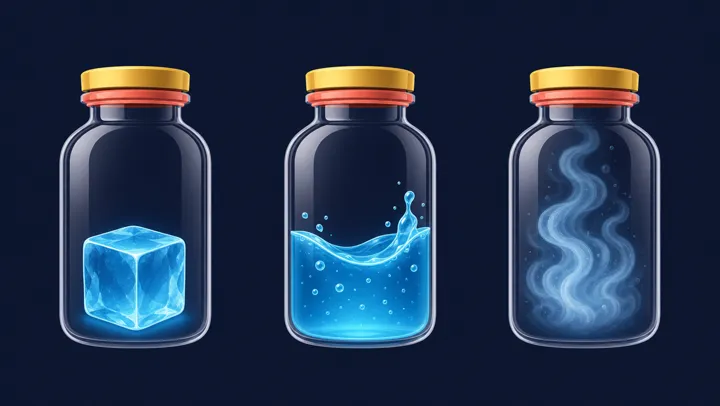
Particle motion, phase changes, heating curves and the gas laws — Boyle's law and Charles's law with simulations and practice. 8 free resources on this page.
Simulations, diagrams, worked examples and practice for how pressure, volume, temperature and density are connected in a closed container of gas. You will predict and explain. You will not solve gas law equations; this course only asks you to understand them.
Start here
What you are learning
SPS5. Obtain, evaluate, and communicate information to compare and contrast the phases of matter as they relate to atomic and molecular motion. b. Plan and carry out investigations to identify the relationships among temperature, pressure, volume, and density of gases in closed systems.
Learning target
I am learning to identify how the temperature, pressure, volume and density of a gas are connected in a closed system.
Success criteria
I will be successful when I can:
predict how a gas's pressure changes when its volume changes and its temperature stays the same (Boyle's law)
predict how a gas's volume changes when its temperature changes and its pressure stays the same (Charles's law)
explain every change using the motion of the gas particles
plan and carry out a gas investigation and read the graph it makes
TTemperature
How fast the particles move, on average. Hotter means faster.
PPressure
How hard and how often the particles hit the walls of their container.
VVolume
How much space the gas has to move around in.
DDensity
How crowded the particles are: the same particles in less space are more dense.
Closed system means no gas gets in or out. The number of particles never changes in any of these gas laws. Only their speed and the space they have can change.
Part 1
Gas basics: where pressure comes from
Gas particles fly in straight lines until they hit something. Every hit on a wall is a tiny push. Millions of pushes every second add up to pressure. Each gold flash below is one hit.
Try it. Heat the gas. Then add more gas. Both make the pressure rise, but for different reasons. What are the two reasons?
Heating makes the particles faster, so they hit the walls more often and harder. Adding gas makes more particles, so there are more hits. Either way: more pushing on the walls means more pressure. (Adding gas only happens in this warm-up box. In the gas laws below, the amount of gas stays the same.)
Pressure is the push of particles hitting the walls. More hits, or harder hits, mean more pressure. Gas pushes on every wall, not just the bottom.
Temperature tells you how fast the particles move, on average. Cold particles (blue, short trails) are slow; hot particles (red, long trails) are fast. They never stop.
Volume is the space the gas fills. The same 12 particles can fill a big space or a small one. The particles stay the same size.
Particles in every drawing on this page are hugely enlarged. Real gas particles are far too small to see and very far apart compared to their size.
Part 2
Boyle's law: squeeze a gas and its pressure goes up
Boyle's law: When the temperature stays the same, a gas's pressure and volume move in opposite directions. Make the space smaller and the pressure goes up. Make the space bigger and the pressure goes down.
Held steady: temperature, amount of gasV ↓ then P ↑V ↑ then P ↓
Drag the handle, or use the slider
Record points at several volumes. Pressure–volume graphs for Boyle's law make a curve that drops quickly, then flattens out.
How the math works (in words, no equation needed)
Pressure and volume change by the same factor, in opposite directions. Squeeze the gas into half the space and the pressure doubles. Squeeze it into a quarter of the space and the pressure is four times as big. Let it spread into twice the space and the pressure drops to half.
100 mL100 kPa · normal50 mL (half the space)200 kPa · double25 mL (a quarter)400 kPa · four times
Why? The particles did not speed up (the temperature stayed the same) and none were added. But in half the space, each particle reaches a wall twice as often. Twice the hits means twice the pressure. Scientists call this an inverse relationship: when one goes up, the other goes down by the same factor. On a graph it makes a curve, not a straight line.
Predict, then test. Push the piston all the way in to 20 mL. Now pull it back out to 40 mL, so the gas has twice the space. What will happen to the pressure?
The space doubled, so the pressure drops to half (from 500 kPa to 250 kPa). The particles have twice as far to travel between hits, so they hit the walls half as often. Try it on the slider to see the evidence.
Part 3
Charles's law: heat a gas and it expands
Charles's law: When the pressure stays the same, a gas's volume and temperature move in the same direction. Heat it and it takes up more space. Cool it and it shrinks.
Held steady: pressure, amount of gasT ↑ then V ↑T ↓ then V ↓
The weight on the piston keeps the pressure the same
Record points at several temperatures. Volume–temperature graphs for Charles's law make a straight line that rises.
How the math works (in words, no equation needed)
Volume and temperature rise and fall together. Every equal step up in temperature adds about the same amount of volume. That steady pattern is why the graph is a straight line. Scientists call this a direct relationship.
0 °Cabout 93 mL100 °Cabout 127 mL (+34)200 °Cabout 161 mL (+34 again)
Why? Heating speeds the particles up, so they hit the piston harder and more often. That pushes the piston up until the gas has spread out enough that the hits on the piston balance the weight again. Same particles, more space.
Absolute zero. Press Follow the line backward on the graph. If you keep cooling, the line reaches zero volume at about −273 °C. That temperature is called absolute zero: the coldest anything could ever be, where particles would stop moving completely. Nothing has ever been cooled all the way there, and a real gas turns into a liquid long before it gets close.
Part 4
Pressure and temperature: heat a sealed, rigid can
When a gas is trapped in a container that cannot stretch (the volume stays the same), its pressure and temperature move in the same direction. Some books call this Gay-Lussac's law.
Held steady: volume, amount of gasT ↑ then P ↑T ↓ then P ↓
Steel tank: the walls cannot move
Why? Faster particles hit the walls harder and more often. In a stretchy balloon the gas would expand (Charles's law). In a steel can the walls cannot move, so all that extra pushing shows up as higher pressure. That is why spray cans warn you not to store them anywhere hotter than about 50 °C (120 °F) and why car tires look low on a cold morning.
Charles's lawPressure held steadyHeat it → the volume grows.
Boyle's lawTemperature held steadySqueeze it → the pressure grows.
Pressure & temperatureVolume held steadyHeat it → the pressure grows.
Trick for every gas question: first ask "What is held steady?" That tells you which relationship you are using.
Part 5
Density: how crowded is the gas?
Density is how much matter is packed into a space. In a closed system the amount of gas never changes, so the only way to change a gas's density is to change its volume. Less space → more crowded → more dense. More space → less dense.
DensityResponds
Squeeze a gas (Boyle's law) → less volume → more dense.
Heat a gas at steady pressure (Charles's law) → more volume → less dense.
Cool a gas at steady pressure → less volume → more dense.
Heat a gas in a rigid can → volume can't change → density stays the same (only the pressure rises).
🎈
Hot air balloons. The burner heats the air inside the balloon. Hot air expands, so it is less dense than the cooler air around it. (The balloon is open at the bottom, so the extra air spills out.) Denser cool air sinks underneath and pushes the lighter warm air (and the balloon) up. Warm air does not rise because "heat is light." It rises because the same amount of air is spread over more space.
Part 6 · Plan and carry out
Run your own gas investigation
Scientists answer a question by changing one thing, measuring what happens, and keeping everything else the same. Pick a question and run the investigation from start to finish. At the end you get a lab summary you can copy.
1Pick a question
2Plan: name your variables
3Carry it out: run at least 5 trials
Real instruments are never perfect, so your readings wobble a tiny bit. Look at the overall pattern.
4Conclude: what does your data show?
Which particle explanation fits?
Lab summary
Part 7
Worked examples: think it through step by step
Every gas question can be solved with the same four steps. Read the situation, make your own guess for each step, then reveal it.
What is held steady?
What changed?
What happens to the other variable?
Explain it with particles.
Part 8
Gas laws in real life
Decide which relationship explains each one before you flip the card. Remember: ask what is held steady.
Part 9
Myth or fact?
These are the most common mix-ups about gases. Decide, then see the truth.
Part 10
Practice
Ten questions at a time, drawn from a big mix: predictions, graphs, particle pictures and real situations. Every answer explains itself. Press New set any time for different questions.
Sort it: which relationship?
Choose the relationship for each situation, then check your sort.
 Tobin